Artists
Work History

Embrace (2020)

Hull (2019)

Secrets (2022)
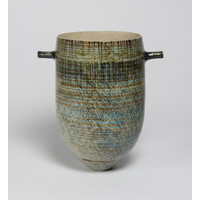
Gaggle I (2026)
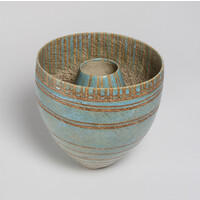
Brood I (2026)

Parley III (2022)

Inclusion II (2020)

Under the Volcano (2019)
Artist Information
“The interior of a vessel can be a space to be inhabited and protected, a void to be crossed or a volume to be shared.”1 At first glance, Phil Brooks’ ceramic pieces seem at home in the long tradition of ceramic vessels. The pieces are functional beakers, vases and bowls that give form to volume whether empty or filled. Brooks confounds this simple concept however, presenting clay extrusions that often disrupt the volume contained by the ceramics. In some cases, the inner space escapes the vessel entirely.
Their sharp-edged shapes and smoothly finished planes appear designed to interlock with one another to serve an indeterminate mechanical purpose. It might come as a surprise to discover that Brooks’ works are the result of the age-old technique of hand-coiling. Once coils are stacked and merged, the resultant form is pared back and smoothed out. Some works are left unadorned, others feature restrained underglazes and clear glazing. Applied surface decoration proposes a tension between the ceramic as a two-dimensional surface and the ceramic as a three-dimensional drawing.
This tension is grounded in Brooks’ background in architecture and design and can be seen in the way she blurs the lines between interior and exterior. Not unlike a Mobius strip or an Escher staircase, the delineation between outer and inner surfaces is unfixed. This in turn disrupts both the space the works enclose and the space they displace. On occasion the exterior surfaces penetrate the space contained within the work; outer walls curve inwards to become part of the interior volume - or do they?
London-born Brooks studied at the Chelsea School of Art and the Architectural Association School of Architecture. After a career in interior design, she started working with clay in 2014. She was the Premier Award winner at the 61st Ceramics New Zealand National Exhibition in 2025 and has been a finalist in the Portage Ceramic Awards numerous times, most recently in 2021 and 2024. She has exhibited at the Pah Homestead and her solo show Pots I Couldn’t Draw was shown at Studio One Toi Tū in 2018.
1. Phil Brooks, artist statement retrieved from https://www.philbrooks.co.nz/about
Solo Exhibitions
Group Exhibitions
All images and text copyright © 2026 the Artists & Milford Galleries Ltd.