Past Exhibitions
Exhibition Works

Lattice No. 217 (2011)

Lattice No. 205 (2010)

Lattice No. 206 (2010)

Lattice No. 193 (2009)

Small Lattice No. 356 (2008)

Small Lattice No. 338 (2008)
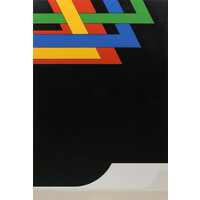
Night Express (1984)

Glamour Express (1985)

Lattice No. 231 (2011)

Lattice No. 226 (2011)

Small Lattice No. 430 (2012)
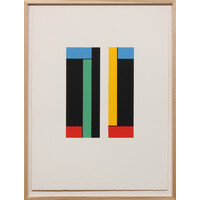
Untitled (1986)

Lattice No. 16 (1977)
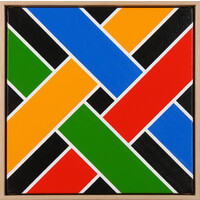
Small Lattice No. 319 (2008)

Small Lattice No. 329 (2008)
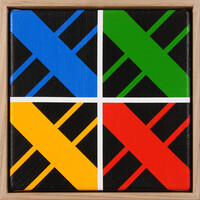
Small Lattice No. 309 (2007)

Small Lattice No. 387 (2009)

Small Lattice No. 427 (2012)
Exhibition Text
One of the ironies of ‘art’ – regardless of whatever discipline – is how the ‘work’ comes to have a life of its own, independent of and coming to be ‘read’ or ‘heard’ or ‘viewed’ in ways which were not at all as first conceived and intended by the maker concerned. This happens when across time and place it transcends its ‘own vocabulary’ and becomes perceived through a much broader cultural lens. In the case of Ian Scott, it was never his intention nor was he ever explicitly referencing weaving patterns drawn from Māori design and culture. Yet, very prominent amongst the numerous substantial attributes of his career’s work is that the New Zealand audience now ‘sees’ that cultural fabric (pun intended) as a key and elemental aspect of his very significant body of work.
Ian Scott pioneered a unique ‘local modernism’ sourced directly from figurative elements, forms and colours present in the late 1970s suburban Auckland landscape and environment. In Art New Zealand, Issue 13, 1979, in reply to questions posed by Michael Dunn he stated that “I’m influenced by the things I see and experience around me every day.” Believing the Lattice patterns to be his own, he added “The first … happened to look like white trellis (fences); the more recent ones like the plastic backs of folding chairs.” Adding, “References are inevitable with the overlapping system, although it’s not what the paintings are about. I happen to like the suburban landscape, with its neatness, bright colours, clean edges – an area of white weatherboards, a touch of bright red curtain to one side, green hedge in front and blue sky above – a very arbitrary, scattered, yet very even sort of colour-order – that is suburbia.”1
In this manner and directly informed by such architectural figuration with (then an essentially primary) palette drawn from his surrounding local community, Scott “tried to make the work more abstract as” he went “along.” He worked “the canvases horizontally on sawhorses… from all sides, so as to treat them like objects.” When questioned by Dunn about pictorial movement and if he saw the Lattices as expansive, Scott replied “I’ve attempted to get a feeling of balanced tension between the sense of movement and expansion of the diagonals and the self-contained nature of the image. I like… the bands running right across and out of the painting in a free uncontained way… yet meeting at the edge of a logical cropping-point…”2
Scott was of course also conjoining his explicitly local modernism with international modernism. Extremely conscious of such dialogues, Scott undertook significant series of works exploring – as, for example, Mondrian and Stella did – vertical and horizontal lines, angled stripes and joints that extended beyond the painting. However, he also resolutely explored tilted and diamond-shaped canvases, built illusionary space, as well as sensations of interlocking patterns (both underneath and over) that set his work distinctly apart from the flatness and idioms of international modernist practice.
This important over-looked aspect of Scott’s entire career – it’s fundamentally local vernacular – has not received the fullest or consistent consideration it so clearly demands. ‘Local Modernism’ openly presents these opinions, seeking to reopen that very conversation begun by Michael Dunn (in 1979) about Scott’s practice and considerable artistic achievements.
1. Ian Scott interview with Michael Dunn, “Ian Scott talks about his Lattice Series”, Art New Zealand, Issue 13, Spring 1979, p. 34.
2. Ibid.
Presented in partnership with Te Kano Estate.

All images and text copyright © 2026 the Artists & Milford Galleries Ltd.